


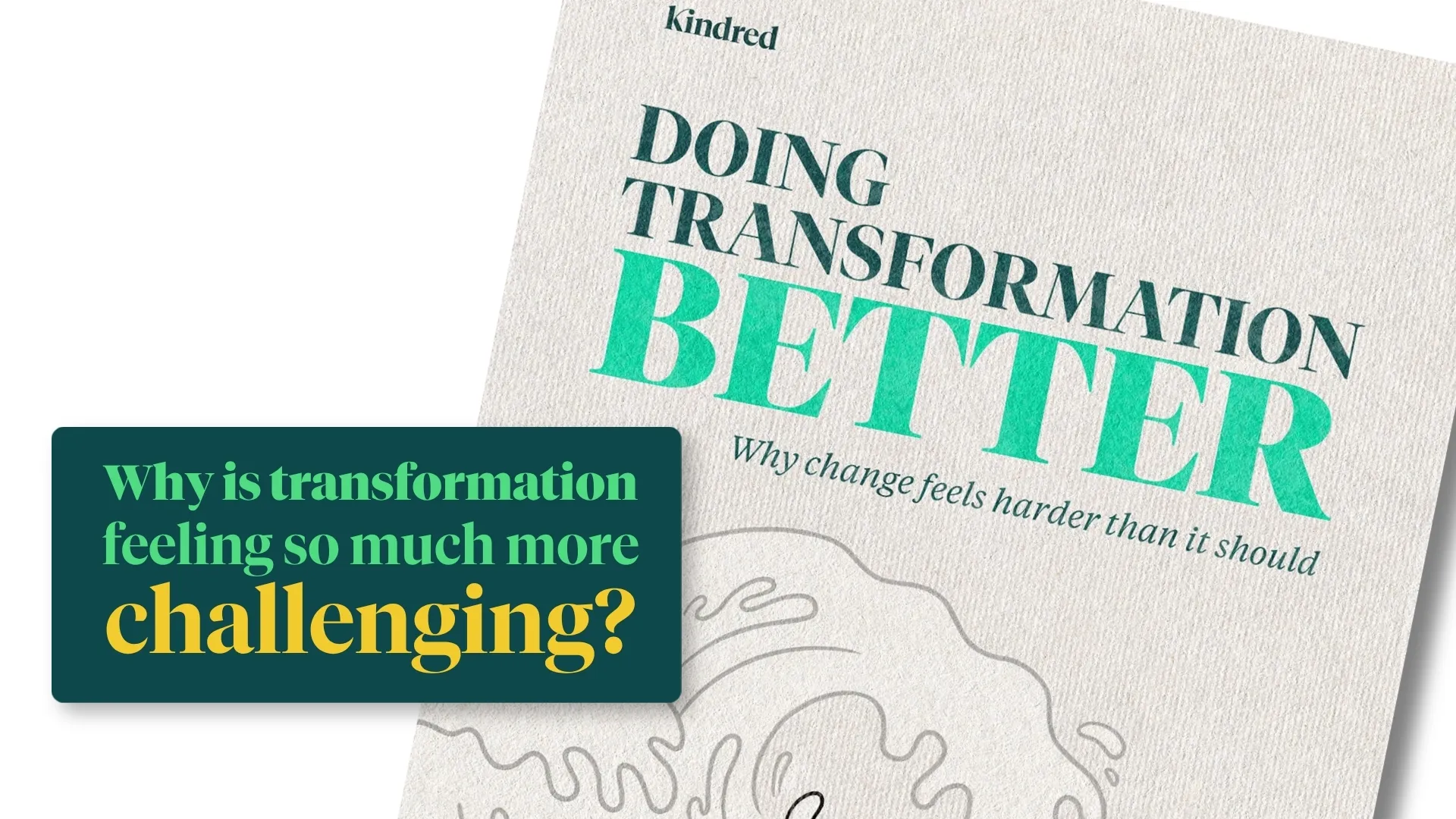
Our newly published report, Doing Transformation Better, explores why transformation is feeling more challenging in organisations today, and why some of the assumptions that once shaped it no longer hold in the same way.
Digital, operational, cultural and strategic change no longer arrive as discrete initiatives with clear beginnings and ends. They overlap, extend and run alongside one another, shaping the context in which work happens day-to-day.
In our work with organisations, we consistently encounter leaders taking transformation seriously. Investment is sustained. Programmes are thoughtfully designed. Leadership attention is high.
Yet many people describe a growing sense that change is becoming harder to absorb and sustain. Initiatives that make strategic sense struggle to embed. Momentum fades more quickly than expected. The effort required to keep change moving feels disproportionately high.
To explore this further, we spoke with leaders and practitioners across sectors including media, energy, telecommunications, retail, financial services and not-for-profit organisations.
The core finding of our research is simple:
Transformation has become continuous, overlapping, and open-ended but many of the models for it have not caught up.
The result is an environment in which change rarely settles, and new initiatives often arrive before the last has landed. We describe this as The Great Accumulation.
This accumulation surfaces in familiar ways:
The meaning of transformation begins to erode
When multiple initiatives are framed as critical, strategic, or transformational, it becomes harder to distinguish what truly matters from what simply carries the label.
Change has nowhere to land
Transformation generates additional demands – new ways of working, new governance, new reporting – while existing responsibilities are rarely displaced.
People adapt by conserving energy
What is often interpreted as disengagement is more often cautious adaptation.
Transformation increasingly carries a sense of personal risk
In a context of ongoing cost pressure, restructuring, automation and role change, transformation is often interpreted as uncertainty rather than progress.
People learn to wait out leadership change
Where transformation efforts are repeatedly reshaped as leadership roles change, people learn to wait and see what endures before investing deeply.
Seen individually, these can appear as separate challenges: credibility erosion, capacity pressure, cautious engagement and leadership churn.
Seen together, they point to something deeper.
Rather than asking how to deliver a specific transformation successfully, leaders are increasingly confronted with a different challenge:
How well is the organisation equipped to absorb ongoing change over time?
This is the question explored in our full report and why we believe organisations need to start thinking about change not simply as something to deliver, but as a capability to build.